

E-commerce websites, retail systems & digital growth
One Product or Thousands.
Build an Online Store Ready to Grow.
From a single-product launch to a large catalogue, retail operation or multi-vendor marketplace, we design and build the storefront, payments, orders, inventory and customer journeys around how your business actually works.
Order journey
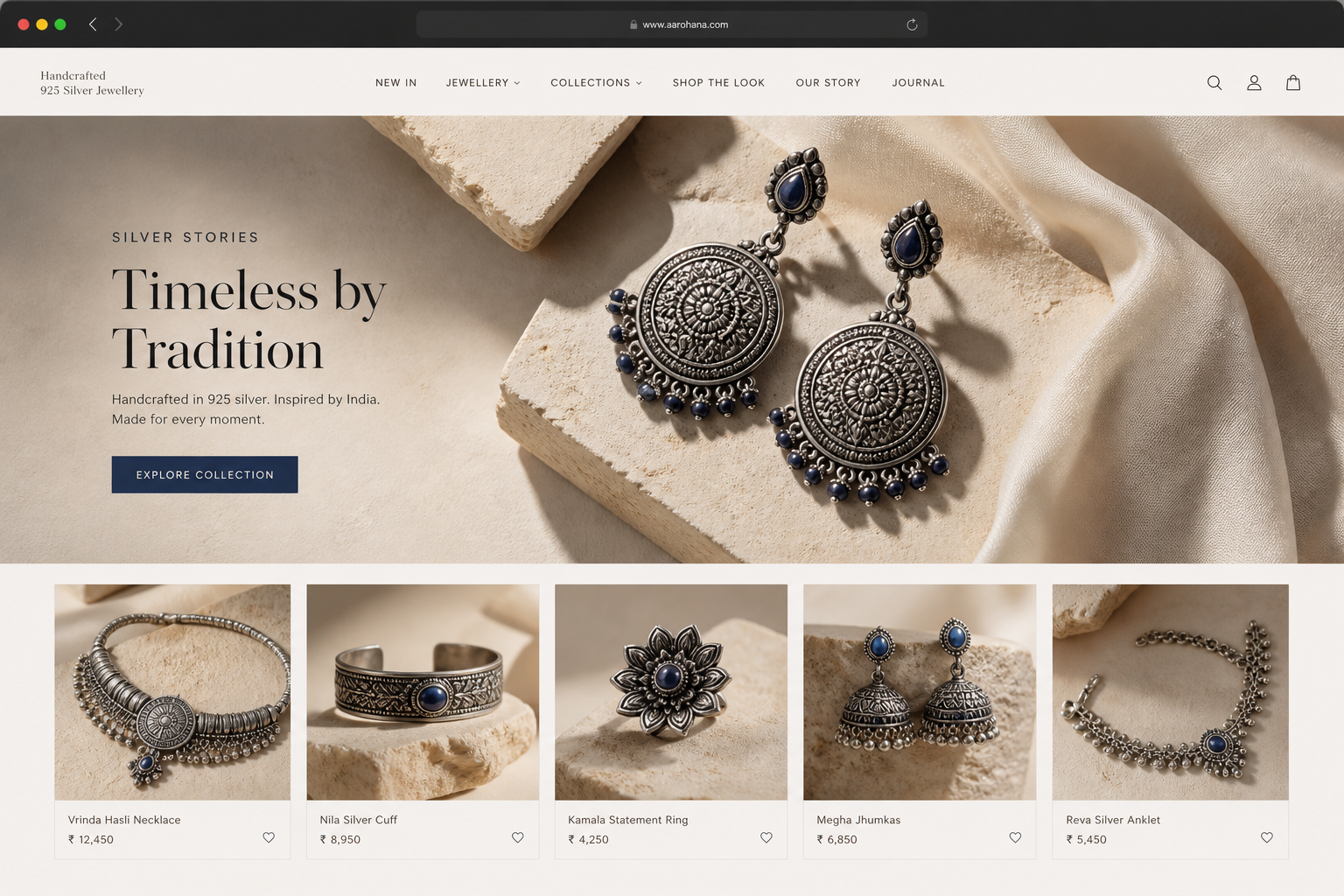
LiveIllustrative store concepts and sample data · not client work
Choose your model
Start with the business you have—not a package you do not need.
Choose the closest model. Each card explains the customer journey, essential features, likely integrations and an indicative investment.
The real e-commerce problem
Selling online is easy to start. Running it well is harder.
Discovery and ordering happen in different places
Customers find you on Instagram, then order over WhatsApp — and neither knows about the other.
Orders are copied by hand
Name, address and item re-typed into a notebook or a sheet, once per order, every day.
Payment screenshots arrive separately
A UPI screenshot in one chat, the order in another, and reconciliation at the end of the week.
Stock is not updated everywhere
Sold out on Instagram, still available on the website, and a refund conversation later.
Shipping questions repeat all day
"Where is my order?" arrives more often than new orders do.
Customers buy once and disappear
No reorder prompt, no review request, no reason to come back.
The goal is not another online store.
It is a smoother buying and selling process.
The complete commerce journey
From First Discovery to Repeat Orders
Eleven stages between a scroll and a second order. Product → inventory → order → payment → shipping → customer → marketing.
One customer, one record
Eleven stages · one order systemInvestment
Start with the commerce technology your business actually needs.
Indicative starting ranges, not fixed quotations. Final pricing depends on products, design, data, integrations, payments, inventory, automation, roles and marketplace complexity.
Single product / micro store
₹15,000 – ₹30,000+
Small e-commerce store
₹25,000 – ₹50,000+
Professional D2C store
₹50,000 – ₹1,00,000+
Advanced / omnichannel
₹1,50,000+
Multi-vendor marketplace
₹2,50,000+ / custom
Optional add-ons
Growth partnership and third-party gateway, messaging and API usage are billed separately.
Questions
What sellers ask before starting.
Clear answers on scope, payments, shipping, marketplaces, apps and growth. If yours is not here, ask it directly—we will answer the question before discussing a proposal.
Getting started
01Can I build a website for only one product?
Yes. A focused one-product store can prioritise storytelling, trust, checkout and repeat purchase without unnecessary catalogue complexity.
02Can you build a website for a home business?
Yes. Handmade, homemade and Instagram-first businesses are a common starting point — catalogue, WhatsApp ordering, payments and shipping without enterprise overhead.
03Can you build an online jewellery store?
Yes. Small catalogues with high-detail photography, variants, made-to-order items and WhatsApp enquiry are well suited to this build.
04What does an e-commerce website need?
Clear product information, real photography, working search, an easy checkout, the payment methods your buyers use, order tracking, returns and a reason to come back.
Payments, orders & shipping
05Can you integrate UPI and COD?
Yes, depending on the selected gateway and your fulfilment model. COD can carry eligibility rules, pincode restrictions and OTP or WhatsApp confirmation.
06Can I sell through both website and WhatsApp?
Yes. WhatsApp supports enquiries, notifications and assisted selling while the central commerce system holds the orders and customer data.
07Can you manage shipping?
Shipping and courier integrations can be added according to provider capability — labels, AWB, pickup, tracking, serviceability and delivery estimates.
08Can inventory be managed online?
Yes, from a single stock location to multiple warehouses and store stock, with reserved, low, out-of-stock, backorder and pre-order states.
09Can a website manage hundreds or thousands of products?
Yes. Large catalogues need faceted search, pricing rules, warehouse-level stock and order workflows — planned from the start rather than retrofitted.
Marketplace, retail & apps
10Can Filari build a multi-vendor marketplace?
Yes. Marketplaces require separate seller, commission, payout and moderation architecture and are custom scoped.
11Can sellers have their own dashboard?
Yes — products, inventory, orders, returns, earnings, settlement and analytics, scoped to that seller only.
12Can marketplace payments be split between sellers?
Only where the payment architecture and provider support multi-party payouts for your legal and business model in your country. This is confirmed during discovery.
13Can I connect my offline shop with my website?
Yes, where your POS or inventory system supports the required integration — shared stock, click & collect, ship-from-store and one customer history.
14Can you build an e-commerce mobile app?
Yes, scoped and quoted separately. A PWA is often the sensible first step before a native iOS and Android build.
Content, AI & growth
15Can an e-commerce website integrate with Instagram and social channels?
Yes, where each platform technically and commercially supports it — catalogue sync, product tagging and attribution back to the order.
16Can AI recommend products?
Yes, as an optional usage-based feature using your approved catalogue data. It never invents price, stock, ingredients, warranty or delivery status.
17Can an online store support multiple languages and currencies?
Yes, with per-language URLs and hreflang, and display currency handled separately from settlement currency.
18Can Filari help market the store after launch?
Yes. Growth work covers category and product SEO, feeds, content, campaigns, festival promotions, WhatsApp journeys, reviews, analytics and conversion optimisation.
19Do you guarantee sales?
No. Filari can improve the technology, buying experience, discoverability and growth execution. Sales depend on product, demand, pricing, margins, competition and many other factors.
From product to customer
You build the product.
We build the digital commerce around it.
Tell us what you sell, how orders work today and where the process is breaking. We will recommend the smallest sensible build that solves the real problem—and explain what can wait.